---
title: VIABLE Engine
description: AI tutors, courses and class lists on your own server, set up in the browser.
updated: 2026-11-05
---
> All VIABLE docs, for people and their agents: https://developers.viablelab.org/llms.txt
# VIABLE Engine
For a school, a library or a lab that wants this running on its own machines, on any model. Nothing here needs VIABLE's hosted
service, and nothing is held back because it is open: add a model and what it makes possible turns on.
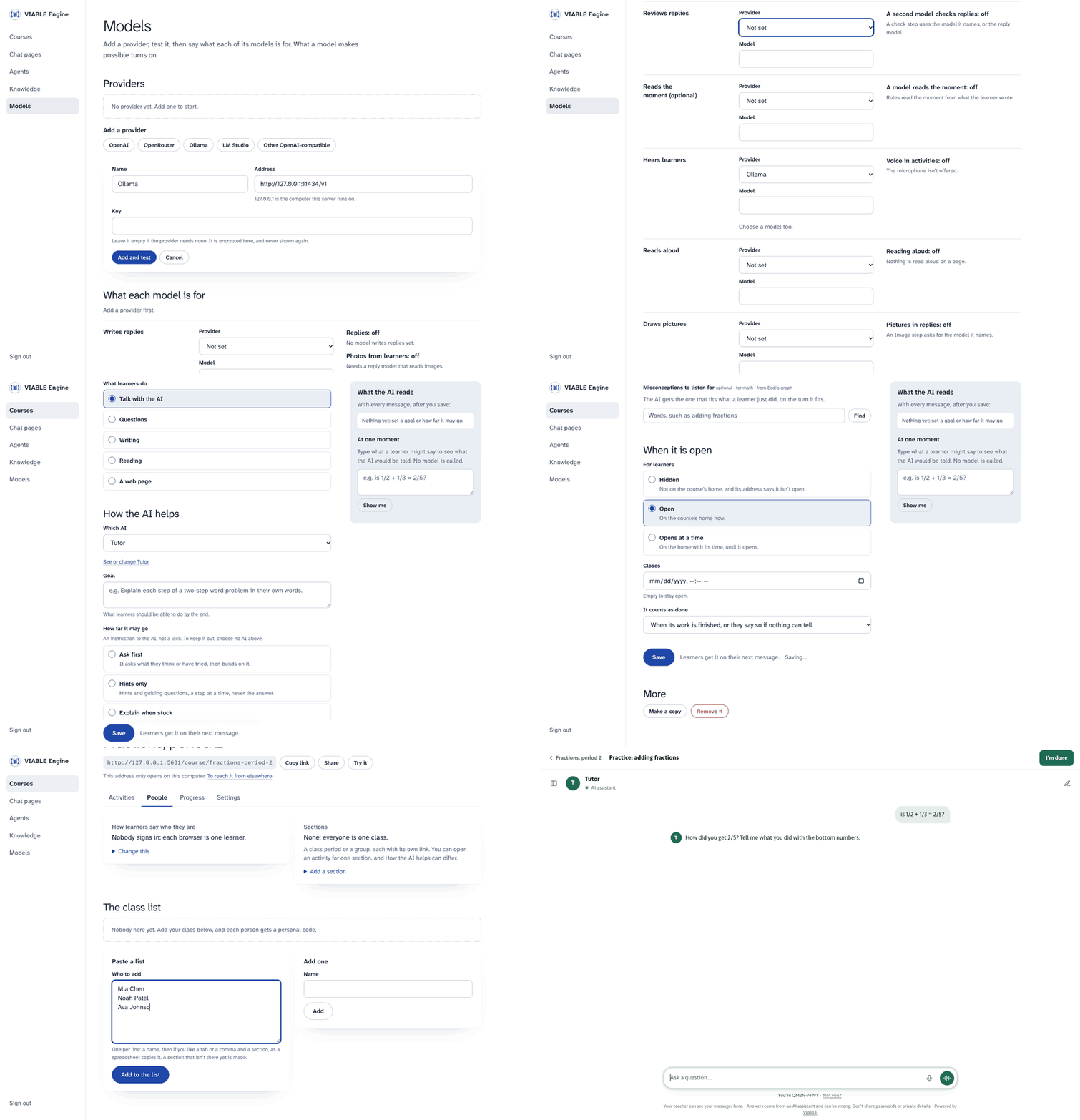
A real server, from empty. Only the model's words are scripted here.
## Ten minutes, from nothing to a class
```sh
npx github:VIABLE-Learning-Lab/viable start
```
It keeps everything in `~/.viable-engine`, and opens its console, signed in.
1. **Models.** Add a provider (OpenAI, OpenRouter, Ollama, LM Studio, or any OpenAI-compatible address), test it, and say what each
of its models is for.
2. **Courses.** Start from nothing, from an example, or from a file.
3. **An activity.** Say what learners do, the goal, and how far the AI may go. Type what a learner might say to see exactly what the
AI would be told at that moment. **Try it**, as a learner, without being counted. Then open it.
4. **People.** Let anyone with the link in, or paste your class list and print a card for each learner with their personal code.
5. **Share** the link or its QR code. A class on your network needs `--host 0.0.0.0`, on a network you trust, since that's plain
http; a class anywhere needs a [server](#where-it-runs) on https.
Then **Progress** shows who has done what, what to look at, and any change the evidence suggests, which you can accept with one
button.
What you change reaches learners on their next message. There is nothing to restart and nothing to publish.
**Or just say it.** With a model set, the console opens on **Ask**: say what you're teaching, and it makes the course, the activities and the questions, showing each step and what it did, and hands back cards to use, such as the link, its QR code and the class list. It can't open anything to learners or delete anything: that waits for your click, enforced on the server. A class list goes in its own box, and names never reach the model.
## What each model turns on
| Role | Calls | What it makes possible |
| --- | --- | --- |
| Writes replies | `/chat/completions` | Replies, word by word. Photos and PDFs from learners, if you say this model reads them |
| Reviews replies | `/chat/completions` | A second model in an agent's check step |
| Sets up classes *(optional)* | `/chat/completions`, with tools | Ask. Otherwise it uses whichever writes replies |
| Reads the moment *(optional)* | `/chat/completions` | A small model picks what each turn needs. Otherwise rules do, in English |
| Hears learners | `/audio/transcriptions` | The microphone: a voice message, dictation, a conversation by voice |
| Reads aloud | `/audio/speech` | Replies read aloud, and an agent's Speech step |
| Draws pictures | `/images/generations` | An agent's Image step |
| Searches by meaning | `/embeddings` | Knowledge search by meaning as well as keywords |
The console shows each one on or off, and why. Keys are encrypted where they are kept, and never come back to a browser.
**Care or speed is yours to weigh.** A check holds a reply back until it passes, so a learner waits for each try: on our first run with a strict
reviewer, 12 to 31 seconds a reply. An agent's page sets how many tries, Models sets how fast a reviewer, and Progress says how long learners
have been waiting.
## A chat button on your website
A library wants research help on its guides' pages, answering from its own guides, on its own server.
1. **Knowledge.** Make a knowledge base, add the guides as files or read them from your website.
2. **Chat pages.** Make a page: its instructions, its knowledge base, how many messages a visitor gets.
3. Copy the one line onto your site, and say which sites may show it.
```html
```
Anyone who can open it can use it on your model keys, up to the limits you set.
## From the Developer Platform
On the Developer Platform, download the course or agent as a package with its files (Courses → ⋯ → Export). In the console:
**Courses → From a file**. Or start with it:
```sh
npx github:VIABLE-Learning-Lab/viable start course.viable.zip
```
| Travels | Stays behind |
| --- | --- |
| Activities, question sets, How the AI helps, agents and their look, chat page settings, knowledge files, website snapshots | Learners and their work, class lists, keys, study data |
A workflow built on the visual editor runs here as it is: you can't redraw it in the console, and you can change its look and page.
The other way works too: **Settings → Download**, then import it on the Developer Platform, where models it doesn't have become
its default, and it says so.
## Where it runs
`viable-engine deploy [package] --out ` writes a folder with its own README and exact commands, and you deploy it
yourself. With no package, the server starts empty and you set it up at `/console`. A course changed there stays in the store.
| Target | Keeps things in | How far it has been tried |
| --- | --- | --- |
| `node` | a folder | run by the tests |
| `docker` | a volume | run under Docker |
| `cloudflare` | D1 | run with `wrangler dev --local` |
| `firebase` | Firestore | run in the Functions emulator; never deployed |
| `aws-lambda` | an S3 bucket | its handler tested; never deployed |
| `cloud-run` | a Cloud Storage bucket as a folder | its image run under Docker; never deployed |
## What it keeps, and who sees it
Everything stays in your store. A learner's name lives only on the class list, and is never sent to a model. Learner records carry a
pseudonymous code. `--keep-days ` deletes what learners wrote after that many days, and
`viable-engine forget ` deletes one learner. [deploying.md](/docs/engine/deploying) lists what the code guarantees, and what is
still yours to do, such as your agreement with each model provider.
## More than the console
```sh
viable-engine start # the console, on a folder of its own
viable-engine serve course.viable.zip --port 8080 # one package, with your flags
viable-engine run agent.json --input "..." # one reply, in a terminal
viable-engine inspect course.viable.zip # what it needs, before you run it
viable-engine verify https://your-server # whether a server works
```
Apps call the same API as the hosted platform (`POST /v1/agents//runs`), so they move by changing an address.
[self-hosting.md](/docs/engine/self-hosting) is the reference: flags, the API, what differs from VIABLE. Others:
[learner-pages.md](/docs/engine/learner-pages), [deploying.md](/docs/engine/deploying), [try.md](/docs/engine/try).
**Not here:** the visual workflow editor, studies with consent and the research export stay on the
[Developer Platform](https://developers.viablelab.org). LTI isn't built. The Engine is built on the
[VIABLE Harness](/docs/harness/overview), which you can use without any of this.
---
This page comes from the open repository: [engine/README.md](https://github.com/VIABLE-Learning-Lab/viable/blob/main/engine/README.md). To change it, change it there.